
Training
Coyote Ridge Serpentine Grasslands Field Trip
COST: FREE
REGISTRATION FOR THIS PROGRAM IS CLOSED
Instructor Information
Stuart Weiss
Consulting Ecologist
Creekside Center fo Earth Observations
Contact
Grey Hayes
grey@elkhornslough.org
(831) 274-8700
Sponsors
Description
See also: Serpentine Grasslands, Maintaining Biodiversity
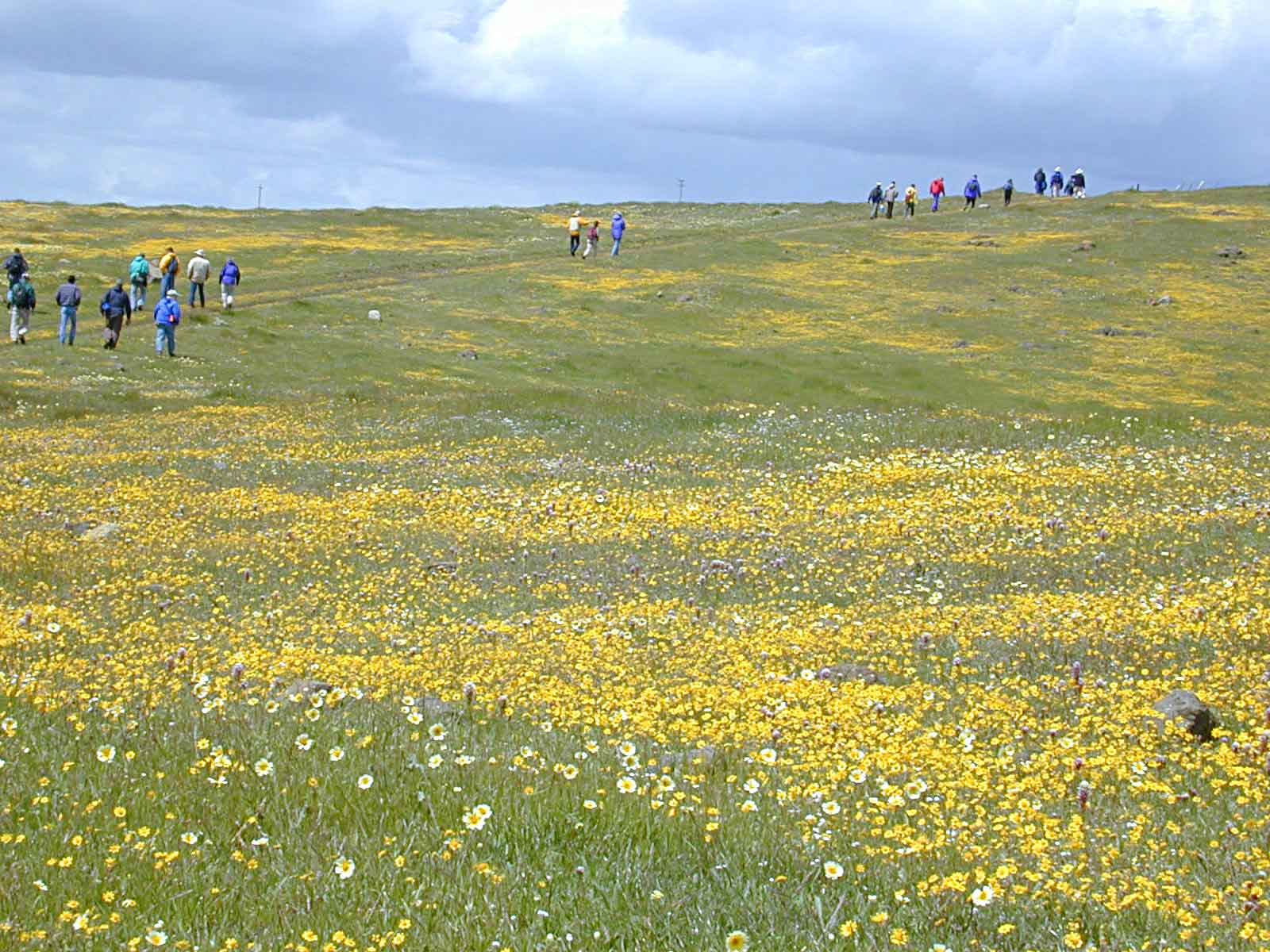
On April 7th, 2005, 28 botanists, land managers, and grassland enthusiasts braved the rain and the wind to visit one of the few areas of serpentine grassland in the greater Bay Area at Coyote Ridge in Santa Clara County. The trip was organized by the Elkhorn Slough Coastal Training Program and led by Dr. Stuart Weiss (stubweiss"at"netscape.net) from the Creekside Center for Earth Observations. Dr. Weiss is an expert in the area's natural history, ecology, and conservation. The day focused on identifying the main threats to serpentine grasslands - the loss of habitat from development and habitat degradation from the invasion of exotic weeds like Italian rye grass (Lolium multiflorum). We learned that exotic weed invasion is of particular concern due to increased nitrogen availability from atmospheric deposition. We discussed how some areas of California are more at risk of increased atmospheric deposition of nitrogen than others because of their proximity to urban centers, highways, and prevailing wind patterns. During the field trip we viewed and discussed several different management approaches including early season and late season cattle grazing. Fence lines where grazing did not occur also provided examples of how species diversity diminishes due to exotic weed invasion without active management. During our visit, we saw several rare bolsos imitacion louis vuitton or threatened species including Mt. Hamilton thistle (Cirsium fontinale var. campylon), Santa Clara Valley Dudleya (Dudleya setchellii), most beautiful jewelflower (Streptanthus albidus var. peramoenus), and the Bay Checkerspot Butterfly (Euphydryas editha bayensis). The presence of these rare or threatened species helped emphasize why proper management and an increased understanding of these systems through research must go hand-in-hand to ensure their persistence. We ended our day with a discussion of what had been learned, what research questions would be most helpful to address in the future, and what needs to take place for this to occur. As always, many questions were raised during the day. Some were answered while others were not. One of the goals of the Coastal training program and this website is to help continue these types of discussions after the event has ended. So please send us your unanswered questions (grey"at"elkhornslough.org); we and our panel of scientists will try and address them.
Documents and Publications
| DOCUMENT | AUTHOR / SOURCE |
|---|---|
| WORKSHOP MATERIALS | |
| Contact List: Coyote Ridge Serpentine Grasslands Field Trip PDF, 79KB |
|
| PEER-REVIEWED PUBLICATIONS | |
| Cars, cows, and checkerspot butterflies: nitrogen deposition and management of nutrient-poor grasslands for a threatened species. PDF, 2.8MB |
Weiss, S.B. Conservation Biology 13(6): 1476-1486 1999 |
| Ecological Effects of Nitrogen deposition in the Western United States. PDF, 730KB |
Mark E. Fenn, Jill S. Baron, Edith B. Allen, Heather M. Rueth, Koren R. Nydick, Linda Geiser, William D. Bowman, James O. Sickman, Thomas Meixner, Dale W. Johnson, and Peter Neitlich BioScience 53(4):404-420 2003 |
| Nitrogen emissions, deposition, and monitoring in the Western United States. PDF, 865KB |
Mark E. Fenn, Richard Haeuber, Gail S. Tonneson, Jill S. Baron, Susanne Grossman-Clarke, Diane Hope, Daniel A. Jaffe, Scott Copeland, Linda Geiser, Heather M. Rueth, and James O. Sickman. BioScience 53(4):391-403 2003 |
| OTHER INFORMATION | |
| Photo 1: Coyote Ridge Serpentine Grasslands Field Trip JPG, 210KB |
Mark Stromberg Elkhorn Slough Coastal Training Program 2005 |
| Photo 2: Coyote Ridge Serpentine Grasslands Field Trip JPG, 124KB |
Mark Stromberg Elkhorn Slough Coastal Training Program 2005 |
| Photo 3: Coyote Ridge Serpentine Grasslands Field Trip JPG, 199KB |
Mark Stromberg Elkhorn Slough Coastal Training Program 2005 |
| Photo 4: Coyote Ridge Serpentine Grasslands Field Trip JPG, 230KB |
Mark Stromberg Elkhorn Slough Coastal Training Program 2005 |
| Photo 5: Coyote Ridge Serpentine Grasslands Field Trip JPG, 125KB |
Mark Stromberg Elkhorn Slough Coastal Training Program 2005 |
| Photo 6: Coyote Ridge Serpentine Grasslands Field Trip JPG, 135KB |
Mark Stromberg Elkhorn Slough Coastal Training Program 2005 |
Links
Special Plants of Coyote Ridge
http://www.stanford.edu/~rawlings/coyote/KCplants.htm
Questions and Answers
Submit a question on this subject and we'll provide an answer. coastaltraining@elkhornsloughctp.org